

Motul Hybrid Petrol Engine Oils

Features, Benefits & Performance Overview
Motul has developed a dedicated range of petrol engine oils engineered to meet the unique operating demands of hybrid vehicles, including frequent start-stop cycles, low engine operating temperatures, fuel dilution, and strong fuel-economy requirements. Two key products in this portfolio are Motul H-Tech 100 Plus 0W-20 and Motul NGEN Hybrid.
Motul H-Tech 100 Plus 0W-20
Product Positioning
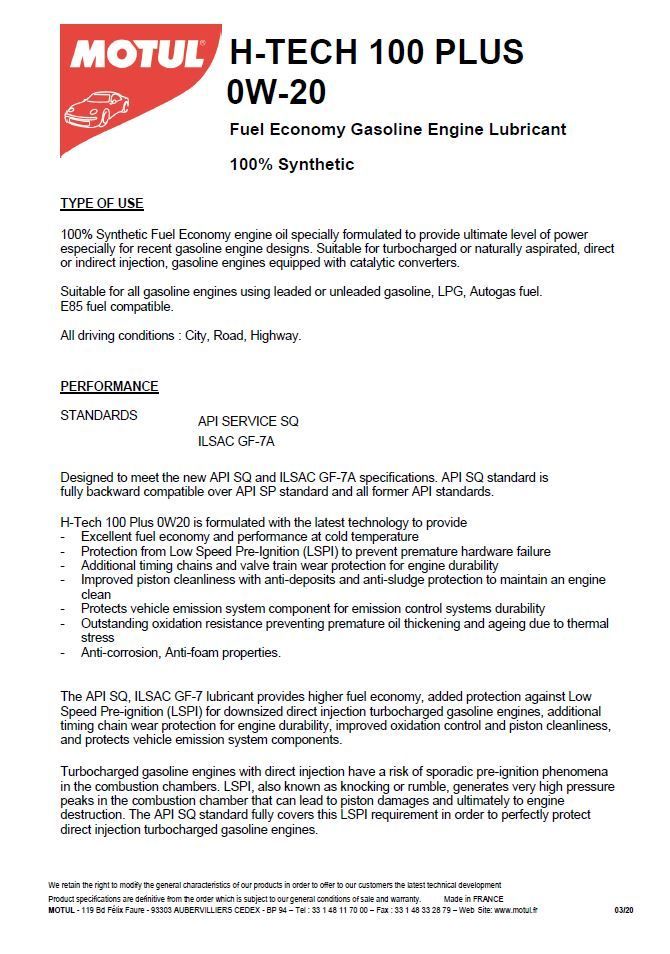
Motul H-Tech 100 Plus 0W-20 is a 100% synthetic fuel-economy engine oil designed for modern petrol engines, including hybrid applications requiring SAE 0W-20 viscosity. It targets reductions in internal friction while maintaining robust engine and emissions-system protection.
Key Features
- Ultra-low viscosity SAE 0W-20 formulation for reduced hydrodynamic friction
- Advanced anti-wear and detergent additive system to maintain piston and valve-train cleanliness
- Strong oxidation resistance to prevent oil thickening under thermal stress
- Protection for catalytic converters and emissions-control systems
Performance Standards & Approvals
- API SQ (backward compatible with API SP and earlier categories)
- ILSAC GF-7A (enhanced fuel-economy and LSPI protection requirements)
Ethanol Fuel Compatibility
- Compatible with petrol fuels containing ethanol, including E10
- Demonstrated compatibility with ethanol-containing fuels up to E85, exceeding typical Australian fuel requirements
Fuel Economy Benefits
- Formulated specifically as a “Fuel Economy” oil under ILSAC GF-7A criteria
- Reduced internal engine friction contributes to measurable fuel-consumption improvements versus higher-viscosity oils, in line with ILSAC test protocols
SPECIFICATION DATA
[CLICK IMAGE TO DOWNLOAD]
Motul H-Tech 100 Plus 0W-20
Motul NGEN Hybrid
Product Positioning
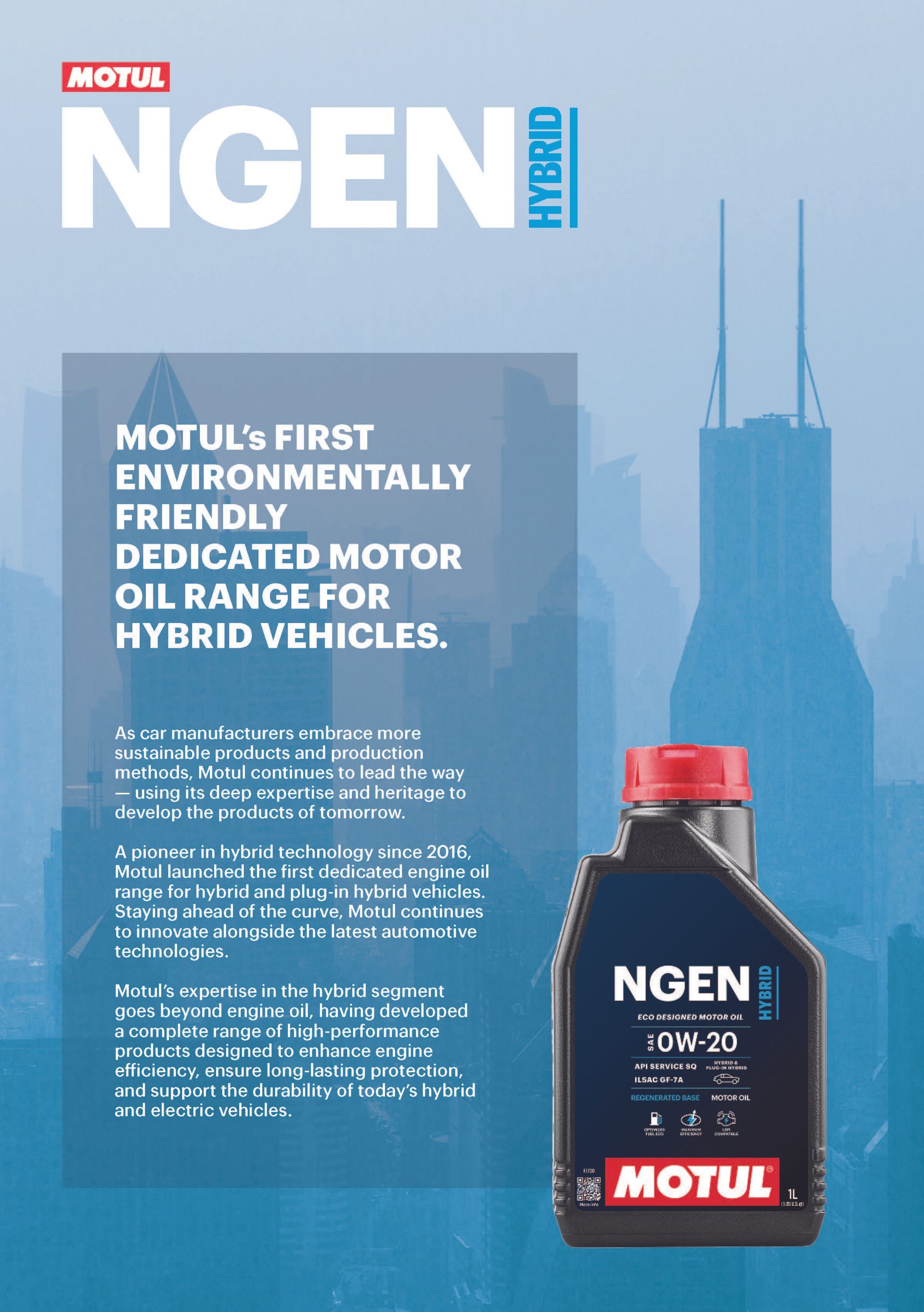
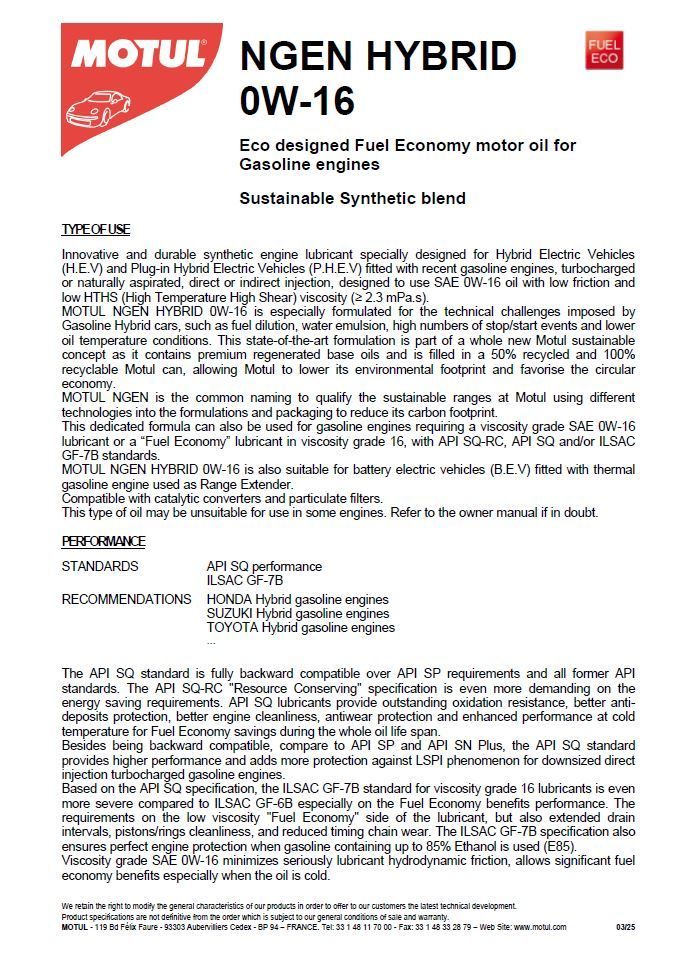
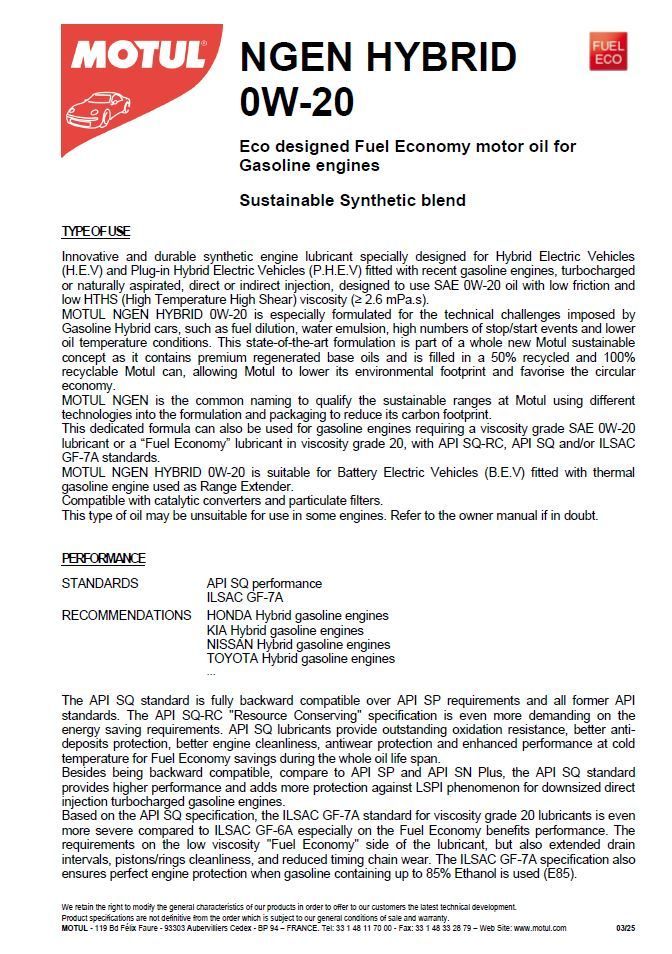
Motul NGEN Hybrid is a next-generation hybrid-dedicated engine oil, developed specifically for Hybrid Electric Vehicles (HEV) and Plug-in Hybrid Electric Vehicles (PHEV). It combines high-performance lubrication with Motul’s sustainability strategy, incorporating regenerated base oils and recycled packaging.
Key Features
- Designed to handle frequent start-stop cycles, fuel dilution, and low operating temperatures typical of hybrid engines
- Faster oil circulation and improved cold-start protection versus standard 0W-20 oils
- Enhanced protection against Low Speed Pre-Ignition (LSPI) in direct-injection petrol engines
- Eco-designed formulation using regenerated base oils and 50% recycled plastic packaging (variant-dependent)
SPECIFICATION DATA
[CLICK IMAGE TO DOWNLOAD]
NGEN HYBRID 0W-16
SPECIFICATION DATA
[CLICK IMAGE TO DOWNLOAD]
NGEN HYBRID 0W-20
Performance Standards & Approvals
(Depending on viscosity grade, e.g. 0W-20 or 0W-16)
- API SQ
- ILSAC GF-7A (latest generation fuel-economy and durability standard)
These standards represent a significant step beyond API SP / ILSAC GF-6, particularly in fuel-economy retention across the oil’s service life.
Ethanol Fuel Compatibility
• Fully compatible with petrol fuels containing ethanol, including E10
• Designed to manage fuel dilution effects commonly associated with ethanol-blended fuels in hybrid engines
Published Fuel Economy Test Data
Motul has published internal road-rolling and laboratory test results demonstrating:
- Up to 8.1% improvement in fuel economy versus an industry-standard 0W-20 oil
- Up to 45 km additional driving range per 36-litre fuel tank, based on Motul comparison testing
- 10% improvement in cold-start lubrication performance, supporting reduced wear during hybrid stop-start operation
NGEN HYBRID LEAFTLET
[CLICK IMAGE TO DOWNLOAD]