Executive Summary On AI and Vehicle Safety
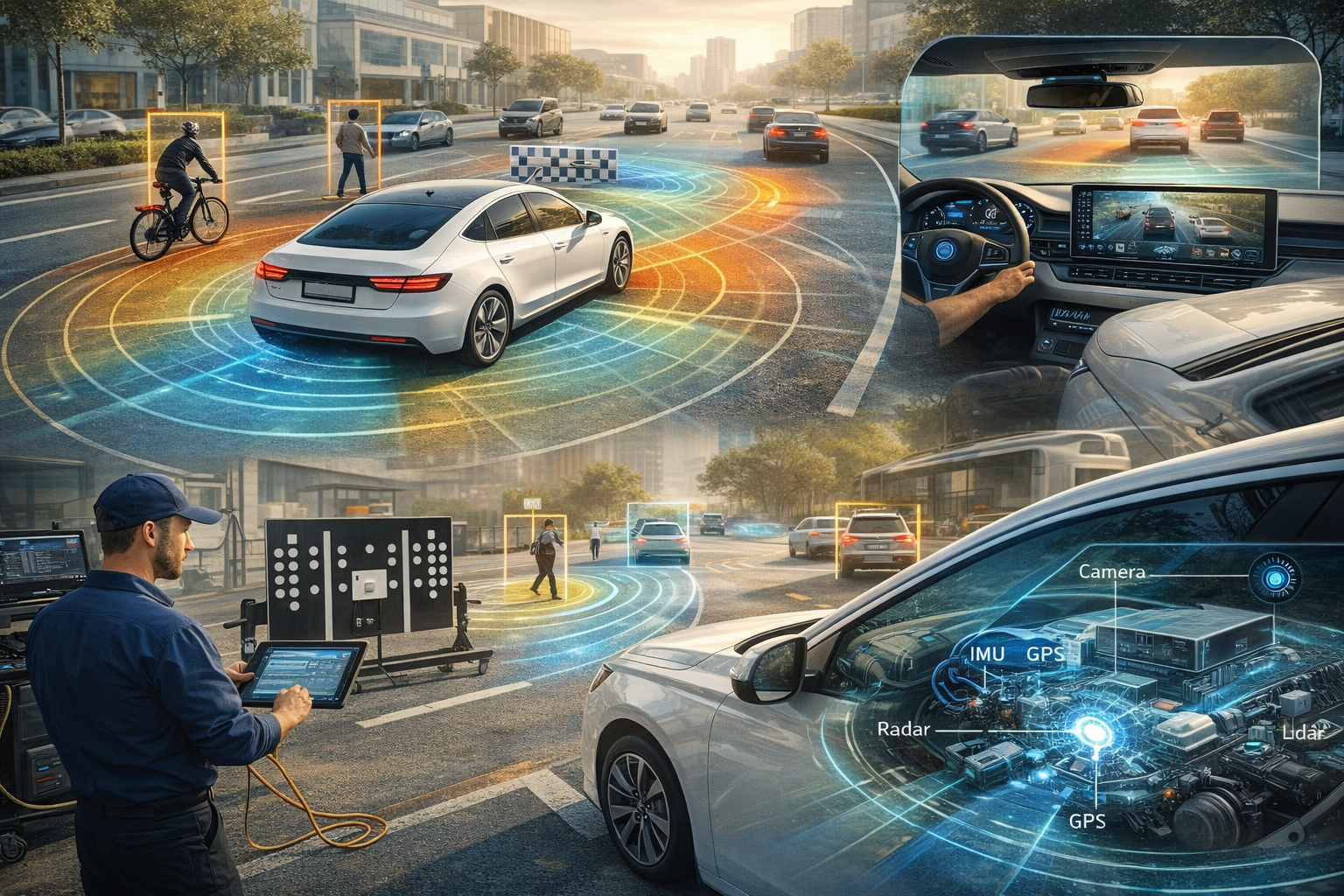
AI is now core to the latest generation of ADAS: deep-learning perception stacks, on-board real-time inference and sensor fusion enable crash-avoidance features that demonstrably reduce collision rates (notably AEB/FCW), while vehicle dynamics control is evolving from rule-based ESC to predictive, AI-assisted torque-vectoring and integrated stability management. Modern systems combine camera/radar (and in some programs lidar, mapping and environmental sensing) to detect, predict and act within fractions of a second; this increases safety but also creates new service obligations — precise sensor calibration, validated software/firmware management, authenticated OTA updates and documented post-repair procedures.
Real-time crash-prevention systems (what they are, how AI changes them)
What they are
- Real-time crash prevention (RTCP) systems are ADAS functions that detect imminent collisions and autonomously intervene (automatic emergency braking — AEB, steering intervention, pre-tensioning restraints, active suspension adjustments). Early systems were rule/threshold based; contemporary RTCP uses neural-network vision stacks, radar processing and probabilistic threat models to predict collision likelihood and decide interventions within tens of milliseconds.
How AI improves real-time prevention
- Faster, richer perception: DNNs process camera imagery to detect pedestrians, cyclists and small objects where older heuristic detectors failed. This raises detection range and reduces false negatives in complex scenes.
- Contextual prediction: Modern systems estimate trajectories (who will move where) using learned models rather than simple linear extrapolation, enabling earlier and more appropriate braking or steering.
- Environment-aware braking: New sensor combinations (e.g., tire-based friction sensing prototypes) and weather/wheel slip inputs let the system adjust intervention aggressiveness to road/grip conditions. Demonstrations (Goodyear SightLine) show how surface sensing could be used to alter AEB thresholds.
Evidence of effectiveness
- Large independent evaluations (IIHS and other real-world studies) show front crash prevention systems (FCW + AEB) substantially reduce rear-end crash involvement and injury risk; automakers’ AEB performance has improved materially in recent model cohorts. IIHS Crash Testing+1
Examples (who is using what)
- Tesla: camera-focused vision stack (multiple cameras + DNNs) driving FSD and AEB features on many Model lines. Tesla emphasises vision and large-scale fleet data for model improvement.
- Waymo/Google & Chinese OEMs (Baidu, Huawei/partners): multi-sensor stacks including lidar/radar/camera for urban ADS and advanced crash-avoidance in testing/commercial programs.
- Multiple OEMs: recent IIHS results show many 2024–2025 models scoring well in front crash prevention tests (wider AEB performance in modern vehicles).
Service / recalibration implications (RTCP)
- Sensor alignment and calibration — camera aim, radar mounting/aim, and any lidar orientation must be verified after windshield work, bumper repairs, suspension/wheel alignment or radar replacement. Calibration errors degrade perception and can disable AEB or cause late/over-aggressive interventions. Use OEM-specified static targets or dynamic procedures and follow the OEM scan-tool workflow.
- Road-driven (dynamic) calibrations — many camera systems require a calibrated drive on well-marked roads at specified speeds (dynamic calibration) to finish alignment; this can take 30–60+ minutes depending on make/model. Technicians must log the calibration and include final confirmation codes in the service record.
- Software state & OTA — crash-prevention relies on current models and maps. Confirm software/firmware versions after repairs and apply authenticated OTA updates where the OEM requires; log all updates. Maintain chain-of-custody for event data if investigating an incident.
AI-enhanced vehicle stability control (predictive stability, torque-vectoring)
What’s changing
- Traditional ESC/ESP applies braking and/or reduces engine torque when a loss of control is detected. AI-enhanced stability systems add predictive layers: ML models use multi-sensor inputs (steering angle rate, yaw rate, wheel speeds, lateral acceleration, camera vision of road curvature, GPS/IMU and even friction estimates) to predict loss of control before it occurs and proactively modulate torque distribution, regenerative braking and active differential/torque-vectoring actuators. Vehicle dynamics experts characterise this as moving from reactive correction to predictive stability management.
Key enabling technologies
- Torque-vectoring actuators & e-axles: EVs and AWD systems with motor-by-wheel control allow extremely fast torque redistribution under ML guidance.
- High-rate sensor fusion: combining high-frequency IMU data with camera lane geometry and wheel slip models lets the predictive controller estimate imminent understeer/oversteer and respond in <50 ms.
- Adaptive behaviour learning: systems can adapt to driver style and road conditions, improving intervention timing and reducing driver surprise. OEMs are trialling “learning” seat-belt pre-tension and restraint strategies tied to predicted crash vectors (Volvo experimental features).
Examples (OEMs / models)
- Performance & EV brands: cars with individual motor control (e.g., some Lucid, BMW i-series, high-end EVs and EV performance submodels) are already using torque-vectoring with electronic control that can be extended by AI controllers. Industry panels (Vehicle Dynamics experts, 2025) show OEMs are prioritising AI in dynamics control.
- Volvo (announced features): Volvo has publicly discussed occupant/seatbelt AI and integrated safety functions in upcoming models — a sign manufacturers are integrating predictive occupant protection with dynamics control.
Service / recalibration implications (stability control)
- Wheel speeds and IMU offsets: suspension, wheel bearing or tyre changes can alter wheel speed sensors and IMU alignment — these must be checked and recalibrated where OEM procedures require. Mis-matched wheel sensor readings can confuse torque-vectoring logic.
- Powertrain control & motor calibration: EV motor controllers and e-axle assemblies often require post-replacement coding and validation runs; technicians must use OEM high-level tooling to re-initialise torque-vectoring parameters.
- Test & validation drives: after repairs to suspension, steering or electronic controls, complete OEM-required dynamic validation (closed course or specified road tests) to prove the stability functions behave correctly and to produce service records for liability.
Deep dive C — Multi-sensor fusion for better situational awareness
What it is
- Multi-sensor fusion combines camera, radar (millimetre-wave), ultrasonic, GNSS/IMU and optionally lidar and external crowd-sourced mapping to produce a coherent, time-synchronised world model. AI (DNNs and sensor-fusion probabilistic filters) resolves conflicting sensors, fills single-sensor blind spots and weights inputs by reliability (e.g., radar in poor light, camera for classification).
Why it matters
- Fusion improves detection in poor visibility (rain, night), reduces false positives, enables longer and more accurate path prediction and supports higher-level manoeuvres (lane-centering, automated lane changes, urban ADS). It is also central to NCAP/UNECE expectations for advanced ADAS.
Examples
- Mobileye (EyeQ + Drive platform) — published multi-layer fusion architectures (camera + imaging radar + optional lidar) and is offering Drive™ stacks for OEMs and fleets; Mobileye’s approach shows how separate redundant perception channels are architected.
- Waymo / Baidu / Huawei — commercial ADS use lidar + radar + cameras with HD maps and global localisation for urban driving. Huawei’s integrated offering to OEMs bundles sensors, compute and path-planning solutions.
- Tesla — fleet-scale camera + radar history (Tesla has trended toward camera-only in some roadmaps) emphasises heavy reliance on vision and massive labelled data rather than lidar; some competitors favour lidar + radar + camera fusion. This illustrates two different engineering philosophies in the market.
Service / recalibration implications (fusion)
- Cross-sensor alignment: camera pointing, radar mounting angle, IMU alignment and GNSS antenna placement all matter. A single misaligned sensor can degrade the fused world model; OEM procedures exist to re-register sensors after structural or sensor replacement.
- Redundancy checks: fusion systems expect consistent inputs; post-repair tests must validate sensor consistency (e.g., compare radar-measured distances to camera detection at test speeds). Use manufacturer diagnostics that show sensor fusion health flags.
- Map & localization updates: systems that rely on HD or crowd maps may need map refresh or re-initialisation after control unit replacement; technicians must confirm map versions and localisation health.
Practical checklist for technicians
- Purchase and register OEM calibration tooling and subscriptions (OEM lists are the authoritative source for calibration requirements by make/model). Keep licences current and record calibration certificates.
- Standardise post-repair workflows (static target calibration, dynamic road calibrations, software version checks, OTA confirmation and EDR log capture). Require signed service records with timestamps and confirmation codes.
- Add an ADAS + Dynamics module to CPD — include sensor fundamentals, fusion basics, motor/e-axle calibration, dynamic validation drives and cybersecurity/OTA handling. Make the training auditable.
- Implement data-handling & chain-of-custody procedures for event logs and OTA records in case of incidents and insurer/regulator enquiries.
- Monitor regulatory & NCAP changes — IIHS/NCAP front-crash test updates and UNECE WP.29 changes affect what ADAS must do and how performance will be measured.
Top load-bearing citations
- IIHS — front crash prevention performance improvements, 2025 evaluations.
- Mobileye — Drive™ and multi-channel sensor fusion architecture.
- Tesla and industry summaries — camera-based large-scale fleet learning approach.
- OEM calibration references — calibration required after windshield, bumper, radar or sensor work; static and dynamic processes.
- Market/technical reports — AI enabling real-time sensor fusion and predictive controller functionality across ADAS and vehicle dynamics