




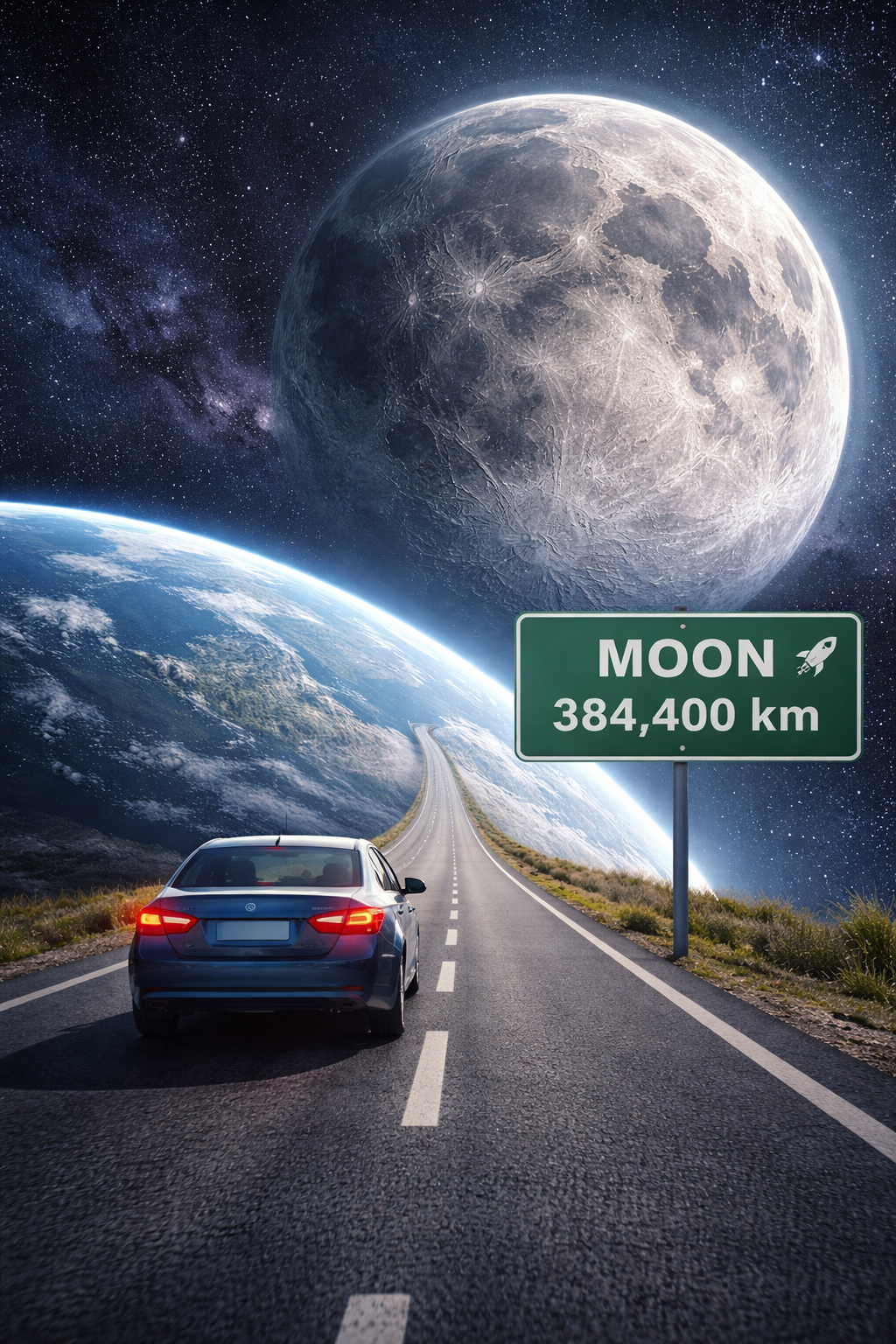
It’s a fun thought experiment: what if you could hop in your car and drive all the way to the Moon? While it’s not physically possible, imagining the journey helps put into perspective just how far away Earth’s closest neighbour really is.
The average distance from Earth to the Moon is about 384,400 kilometres. If you were able to drive non-stop at a steady speed of 100 km/h—without breaks, traffic, or fuel stops—it would take roughly 160 days to get there. That’s just over five months of continuous driving, or realistically around six months when factoring in rest and practical limitations.
To put that into context, driving across Australia from coast to coast takes only a few days. Even a trip around the entire country would be completed in a fraction of the time. The journey to the Moon, by comparison, is on a completely different scale.
Of course, there are a few obvious challenges. There are no roads, no atmosphere, and certainly no fuel stations between Earth and the Moon. Space travel requires escaping Earth’s gravity, something only powerful rockets have been able to achieve—most famously during missions like Apollo 11 Moon Landing.
Interestingly, spacecraft make the trip far quicker than our imaginary car. The Apollo missions took about three days to reach the Moon, travelling at speeds far beyond anything achievable on Earth’s roads.
So while driving to the Moon isn’t an option, thinking about it in these terms gives us a clearer appreciation of distance, speed, and the incredible achievements of space exploration. What feels like a manageable road trip quickly becomes a months-long journey—reminding us just how vast space truly is.