


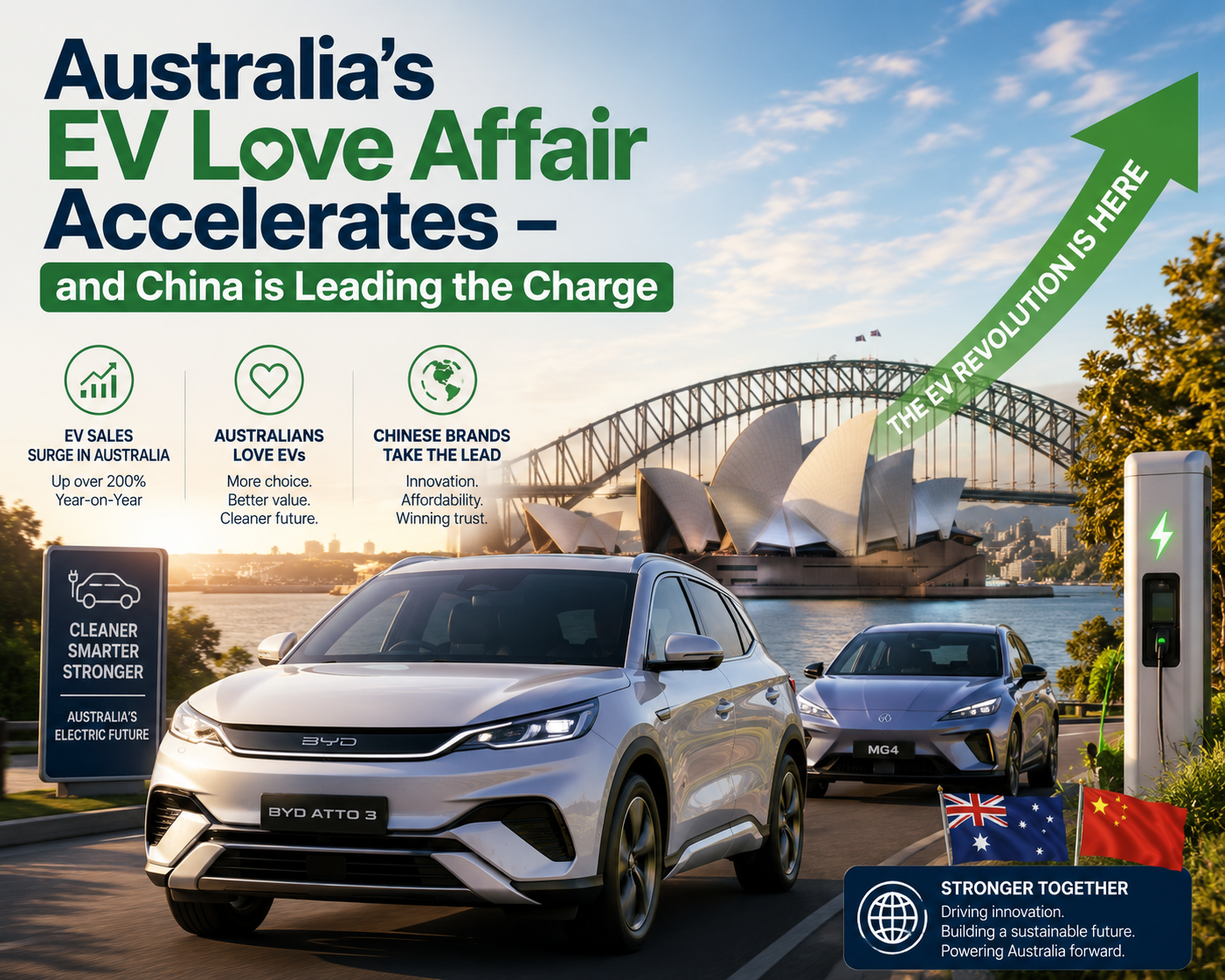
Australia’s EV Love Affair Accelerates – and China is Leading the Charge
Across the Tasman this week, Chinese automotive giant BYD confirmed that almost 5,000 electric and plug-in hybrid vehicles are currently bound for Australia aboard its own dedicated vehicle carrier, the BYD Zhengzhou. The shipment, carrying 4,810 vehicles, marks the first Australian voyage of one of BYD’s purpose-built roll-on/roll-off vessels and is expected to dock in Melbourne before continuing to Sydney and Brisbane.
What makes this story significant is not simply the size of the shipment, but what it says about the Australian market. BYD has already announced plans to bring an additional 30,000 new-energy vehicles to Australia in the coming months as demand for electric vehicles and hybrids continues to surge.
For decades, Australian motorists were among the most loyal supporters of Japanese manufacturers, with brands from Toyota, Mazda, Mitsubishi, Nissan and Honda dominating local driveways. Few industry observers would have predicted that Chinese brands would achieve such rapid acceptance. Yet Australian consumers have embraced brands such as BYD, MG, GWM, Chery, Geely, Zeekr and others with remarkable speed, treating many of them as though they have been established players for generations.
Australia’s transition mirrors trends seen throughout Europe and North America, where consumers are increasingly seeking lower running costs, improved technology, longer warranties and electrified drivetrains. The difference in Australia is that much of this growth is being driven by Chinese manufacturers rather than traditional Western brands. Affordability, strong specifications, competitive warranty programs and rapid product development have reshaped buyer perceptions almost overnight.
BYD’s decision to deploy its own shipping fleet to Australia is perhaps the clearest signal yet that global manufacturers now view Australia as a strategic growth market. When a manufacturer is prepared to invest in dedicated logistics to deliver thousands of vehicles directly to Australian customers, it demonstrates confidence not only in its products but also in the appetite of Australian motorists for electrified transport.
The message is simple: Australia's EV and hybrid revolution is no longer coming—it has arrived, and Chinese manufacturers are playing a leading role in shaping the next chapter of the nation's automotive landscape.