


Ethanol-Blended Fuels: A Technical Imperative for Australia’s Fuel Security and Automotive Future
Australia is operating in an era of heightened fuel insecurity. Repeated national and international reporting has confirmed that Australia’s refined fuel security buffer remains critically low—often cited at approximately 30 days—leaving the nation exposed to geopolitical disruption, supply-chain shocks, and international market volatility. Against this backdrop, the promotion and responsible adoption of ethanol-blended fuels (E-fuels) is not a political abstraction; it is a practical, technically defensible, and nationally strategic response.
This article calls on automotive technicians, engineers, and industry leaders to actively support the informed use of E10 and the proposed low-level ethanol blends (E2–E5), we also need to dispel the persistent myths regarding vehicle damage and environmental harm, and assist in educating the public using sound mechanical and engineering principles.
The Australian automotive practitioner is uniquely positioned to lead this conversation with authority to our clients.
Australia’s Fuel Security Reality
Australia imports the overwhelming majority of its refined petrol. In recent years, multiple national news outlets and government briefings have highlighted that Australia’s fuel reserves sit well below International Energy Agency benchmarks. This reality is not speculative—it is structura
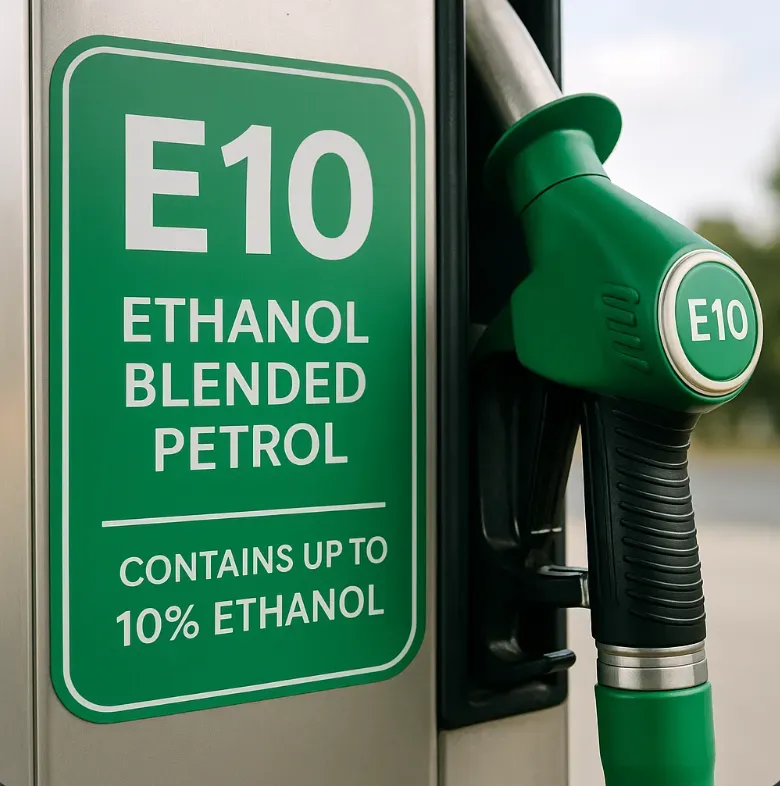
Low-level ethanol blending offers three immediate national advantages:
- Fuel supply diversification, reducing reliance on imported refined petrol
- Domestic energy resilience, through Australian-produced ethanol
- Incremental emissions reduction, without requiring fleet replacement
Ethanol is not a future fuel, it was there from the start of the ICE. It is a present-day mitigation tool already proven globally as an automotive petrol supplement or in some countries the primary fuel source (E100).
One of the most enduring misconceptions in the Australian market is that ethanol damages engines or fuel systems. This belief is outdated, incomplete, and technically inaccurate when applied to modern E Fuel compliant vehicles.
The majority of vehicles currently operating on Australian roads are E10-compatible by design. This reflects global vehicle engineering standards, not local political decisions.
Global manufacturers such as Ford, General Motors, and Toyota manufacture vehicles for international markets—including California—where E10 and E15 fuels are standard. These vehicles share platforms, materials, and fuel-system architectures with those sold in Australia.
Ethanol acceptance is therefore not an exception; it is the global norm.
Lets review the proposed E2 blend or supplementation (2% Ethanol). It would have;
- Negligible operational impact on modern vehicles
- No perceptible change to drivability or performance
- Minimal material interaction, even in older vehicles
- Broadly compatible across the current Australian fleet
Proposed E3 blend (3% Ethanol);
- Enhanced fuel-system cleansing effect
- Possible short-term fuel-filter loading during transition
- Fully manageable through routine maintenance practices
Prosed E5 blend (5% Ethanol);
- Still technically manageable for most vehicles
- Requires clear consumer education, particularly for older vehicles
Importantly, ethanol’s solvent properties are often mischaracterised as harmful. In reality, they can remove long-accumulated deposits in fuel systems. While on the other hand Ethanol used or blended today has an anti-corrosion inhibitor added. So, a precautionary fuel-filter replacement during the transition phase is both prudent and inexpensive, whilst the ethanol works on cleaning the fuel system.
Vehicles manufactured more than 25 years ago may contain fuel hoses, seals, and the use of elastomers (natural or synthetic polymers, ie neoprene needle and seats) not originally designed for ethanol exposure mat experience service issues, if they have not been changed for a product E Fuel compliant during normal component life spans . However:
- At E2–E5, the risk remains low
- Issues are gradual, not catastrophic
- Most concerns are mitigated through normal component replacement cycles
This does not justify resisting ethanol adoption; it justifies targeted guidance and education, which technicians are well-placed to provide.
With the above in mind, E10 compatibility is already embedded across the greater part of the Australian fleet, E15, however, introduces an important distinction. While the Mechanical compatibility is usually sufficient the Engine calibration or available mapping is the true determining factor, US-market vehicles—particularly those designed for California—are often ECU-mapped to optimise E15. However, many European vehicles, while mechanically tolerant, are calibrated primarily for E10.
Our education role is also to ensure the importance the consumer understands that of matching fuel blend with OEM specifications but also the RON of the stipulated fuel is not forgotten. PE10 can be utilized when a RON greater than 95 is called for.
Remember Ethanol blending does not override manufacturers fuel requirements, Technicians must continue to reinforce that:
- The specified RON rating must always be met
- Ethanol blends often increase octane, not reduce it
- Incorrect fuel selection—not ethanol itself—is the real risk factor
When ethanol percentage and RON align with OEM specifications, there is no technical basis for claims of engine damage.
Some outdoor power equipment (OPE) and legacy small engines were not designed for ethanol-blended fuels. This is a legitimate exception—but it is not representative of today’s passenger on-road vehicle fleet.
Together with clear labelling, consumer education, and correct fuel selection this should address this negative issue around E Fuels, and support our national fuel strategy.
To add positive weight to your conversation with your customer, Ethanol blending delivers environmental benefits through:
- Reduced lifecycle greenhouse gas emissions
- Lower particulate and aromatic hydrocarbon output
- Renewable fuel displacement of fossil imports
Australia also has a strong domestic ethanol supply chain, with producers supporting ethanol production from wheat and other grain stocks to sugar-cane. This represents regional employment, agricultural resilience, and sovereign fuel capability.
Environmental regulators, including state-based EPAs and national frameworks aligned with the Environmental Protection Authority, increasingly recognise ethanol’s role in transitional emissions strategies.
The greatest barrier to ethanol adoption in Australia is not engineering—it is misinformation.
As technicians and engineers, we are the frontline educators. Our role is to:
- Explain that ethanol does not damage compliant vehicles
- Reinforce correct fuel selection practices
- Support consumers through transition maintenance
- Advocate for technically sound, staged fuel policy
Public confidence will not be built by government statements alone. It will be built workshop by workshop, technician by technician
Ethanol-blended fuels are not an experimental risk. They are a globally established, technically mature, and nationally necessary solution.
Australia’s automotive professionals must lead with facts, not folklore.
By supporting the responsible promotion of E10 and low-level ethanol blends, the industry contributes to:
- National fuel security
- Environmental responsibility
- Consumer confidence
- Engineering integrity
The Institute of Automotive Mechanical Engineers encourages its members to engage openly, speak authoritatively, and help Australia move forward—mechanically, economically, and sustainably.