Antonella Abbate • 25 May 2026

BWM's Milestone

For a company long associated with precision internal combustion performance engines and premium driving dynamics, the production of BMW Group’s two millionth fully electric vehicle is far more than a symbolic milestone. It represents a major industrial transition within one of Europe’s most engineering-driven automotive manufacturers.
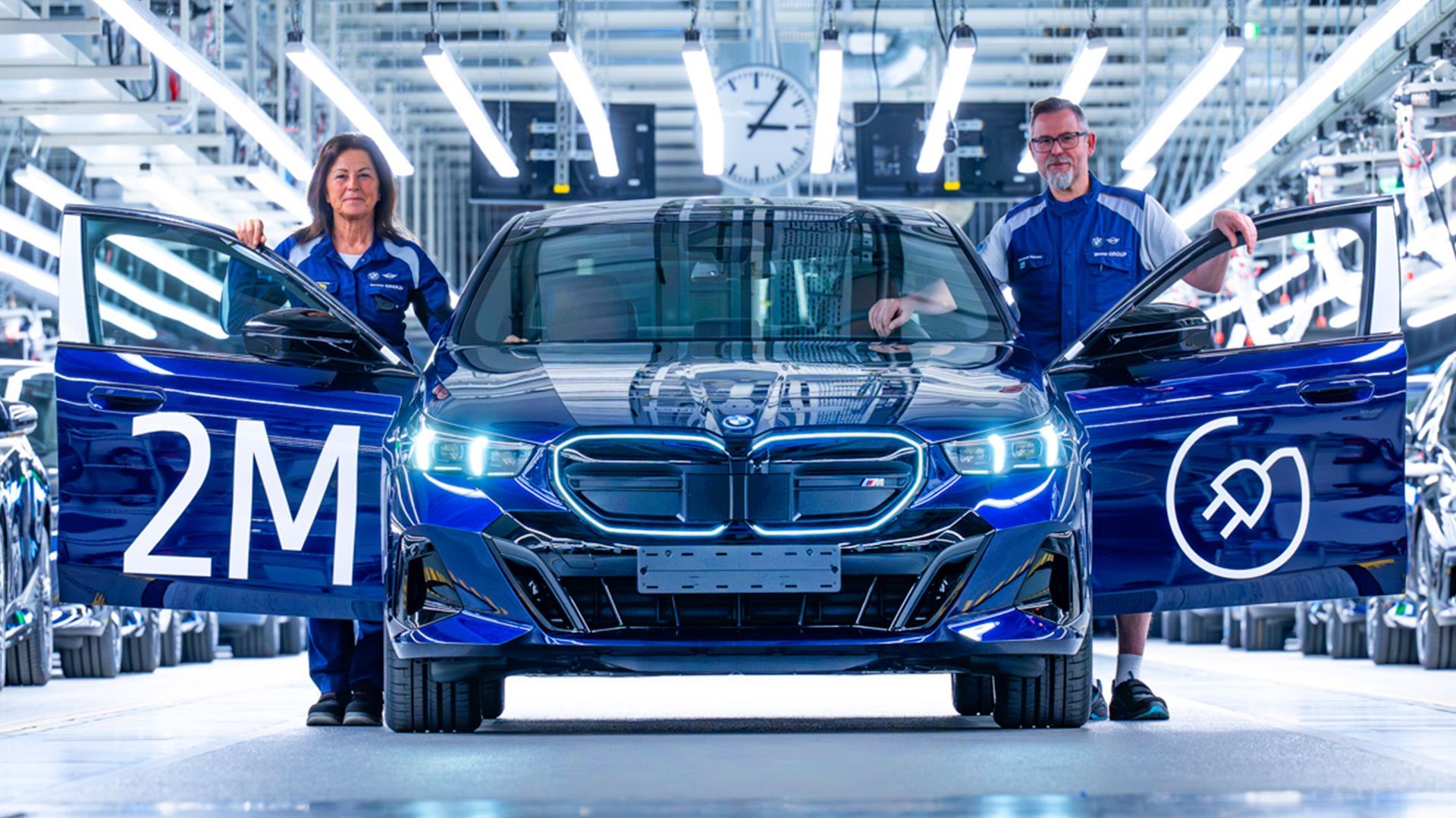
The milestone vehicle, a BMW i5 M60 xDrive built at BMW’s Dingolfing plant in Germany, demonstrates how rapidly the Bavarian manufacturer has scaled its electric vehicle capability while attempting to preserve the traditional BMW identity of performance, refinement and driver engagement. Unlike many newer EV entrants, BMW has not abandoned its legacy production systems entirely. Instead, it has adopted what it describes as a “technology-open” strategy, allowing petrol, diesel, hybrid and fully electric vehicles to be assembled on the same production lines. From a manufacturing perspective, this is a significant achievement. Electric vehicles require substantially different floor structures, high-voltage battery systems, cooling architecture and safety procedures compared with conventional combustion vehicles. Integrating all these variants within one production ecosystem allows BMW to respond to fluctuating market demand without the enormous cost of completely separate EV factories.


This differs from several European competitors that have moved more heavily toward dedicated electric-only platforms and production systems. BMW’s approach is arguably more cautious but potentially more commercially resilient at a time when global EV demand growth has become less predictable than many analysts expected only a few years ago. The Dingolfing facility itself highlights the scale of the transformation occurring across Germany’s automotive sector. Once predominantly associated with luxury combustion-engine sedans, the plant has become BMW’s largest electric vehicle production hub, producing the iX, i5 and i7 models. More than 320,000 EVs have now been built there since electric production commenced in 2021.


While BMW still trails Tesla in total battery electric vehicle volume, among the traditional European premium manufacturers it has emerged as one of the leaders in industrialised EV production. What is particularly significant is BMW’s continued emphasis on performance-oriented electric vehicles. Models such as the i4 M50 and i5 M60 are specifically designed to appeal to drivers who traditionally purchased six-cylinder or V8-powered performance sedans.


Maintaining that performance DNA in an electric era presents major engineering challenges extending well beyond acceleration figures. Electric vehicles are inherently heavier due to battery mass, requiring entirely new approaches to chassis tuning, suspension control, steering feel and thermal management.


Battery enclosure design has consequently become one of the most technically critical areas of modern vehicle engineering. In today’s EVs, the battery enclosure is no longer simply a protective casing. It now functions simultaneously as a structural chassis component, impact protection cell, cooling system housing and thermal safety barrier.


Manufacturers such as BMW increasingly utilise advanced multi-material battery housings combining ultra-high-strength steels, aluminium castings, composite materials and specialised polymers. These structures are designed to absorb crash energy while protecting lithium-ion battery cells from damage and thermal runaway events.


Cooling systems have become equally critical. Modern high-performance EV battery packs contain intricate liquid cooling channels integrated directly into the enclosure assembly to maintain tightly controlled operating temperatures. Without sophisticated thermal management, battery degradation accelerates rapidly and vehicle performance becomes inconsistent under sustained load conditions.


This transition has dramatically increased the diversity of materials now used in modern vehicles compared with traditional performance cars. Steel remains essential for structural safety, but manufacturers now routinely integrate aluminium alloys, carbon fibre composites, engineered polymers, thermal ceramics and specialised adhesives throughout the vehicle.


Chinese EV manufacturers have accelerated this evolution even further. Companies such as BYD, NIO and XPENG have expanded production at a pace unprecedented in automotive history. Unlike legacy European manufacturers burdened by decades of combustion-engine infrastructure, many Chinese EV firms designed their operations entirely around electric vehicle architecture from inception.


The scale differential is enormous. Chinese manufacturers now produce EVs in volumes that exceed many traditional European brands combined, supported by vertically integrated battery supply chains, strong government backing and significantly faster product development cycles.


However, European manufacturers such as BMW still retain strong advantages in chassis engineering, high-speed durability, premium interiors and dynamic vehicle calibration — areas where many newer EV manufacturers are still developing maturity.


BMW’s two millionth EV therefore represents far more than a production statistic. It highlights how one of Europe’s great engineering manufacturers is navigating the most profound technological transformation the automotive sector has experienced in more than a century, while defending its performance heritage against both traditional rivals and the rapidly expanding Chinese electric vehicle industry.


by Antonella Abbate 25 May 2026
Across the Tasman this week, Chinese automotive giant BYD confirmed that almost 5,000 electric and plug-in hybrid vehicles are currently bound for Australia aboard its own dedicated vehicle carrier, the BYD Zhengzhou. The shipment, carrying 4,810 vehicles, marks the first Australian voyage of one of BYD’s purpose-built roll-on/roll-off vessels and is expected to dock in Melbourne before continuing to Sydney and Brisbane. What makes this story significant is not simply the size of the shipment, but what it says about the Australian market. BYD has already announced plans to bring an additional 30,000 new-energy vehicles to Australia in the coming months as demand for electric vehicles and hybrids continues to surge. For decades, Australian motorists were among the most loyal supporters of Japanese manufacturers, with brands from Toyota, Mazda, Mitsubishi, Nissan and Honda dominating local driveways. Few industry observers would have predicted that Chinese brands would achieve such rapid acceptance. Yet Australian consumers have embraced brands such as BYD, MG, GWM, Chery, Geely, Zeekr and others with remarkable speed, treating many of them as though they have been established players for generations. Australia’s transition mirrors trends seen throughout Europe and North America, where consumers are increasingly seeking lower running costs, improved technology, longer warranties and electrified drivetrains. The difference in Australia is that much of this growth is being driven by Chinese manufacturers rather than traditional Western brands. Affordability, strong specifications, competitive warranty programs and rapid product development have reshaped buyer perceptions almost overnight. BYD’s decision to deploy its own shipping fleet to Australia is perhaps the clearest signal yet that global manufacturers now view Australia as a strategic growth market. When a manufacturer is prepared to invest in dedicated logistics to deliver thousands of vehicles directly to Australian customers, it demonstrates confidence not only in its products but also in the appetite of Australian motorists for electrified transport. The message is simple: Australia's EV and hybrid revolution is no longer coming—it has arrived, and Chinese manufacturers are playing a leading role in shaping the next chapter of the nation's automotive landscape.
by Antonella Abbate 25 May 2026
Mr Lamb brings decades of diverse leadership experience across various sectors, both domestically and internationally. Most recently, he served as the Chief Executive Officer of the Murray-Darling Association. Previously, Mr Lamb has held several executive roles with distinct peak body organisations, where he worked closely with government and industry. During his tenure, assisted many organisations to transition into new strategies and methodologies. With his notable experience, he is well positioned to lead the ARC at a time when the refrigeration and air conditioning (RAC) industry is growing at a rapid pace. Mr Lamb succeeds Glenn Evans, who concluded his tenure in December 2025 after 17 years of service. ARC Chair Dr Greg Picker said he was pleased to welcome Mr Lamb to mark the next phase for the Council, which leads national governance of the RAC (also known as ARCtick) Permit Scheme. “The Board is pleased to appoint Mark Lamb as our new CEO. We look forward to working with him as we continue to deliver the ARCtick permit scheme and improve our service to industry. His passion and experience in leading peak body organisations perfectly aligns with the ARC’s priorities at this time and our vision for the future,” Dr Picker said. “It is a crucial time for the industry, and the Board is confident Mark will help us build on our momentum and continue deliver meaning outcomes for the ARC and the broader industry.”  Commenting on his appointment, Mr Lamb said, “I am thrilled to be given this opportunity to play this significant role, not just at the Australian Refrigeration Council, but in the refrigeration and air conditioning industry.
by Antonella Abbate 25 May 2026
The transition has not occurred through the elimination of steel, but rather through its evolution and strategic integration alongside aluminium alloys, magnesium, advanced polymers, carbon fibre composites, structural adhesives, engineered foams, ceramic coatings, thermoplastics and hybrid laminates. Modern vehicles, particularly electric vehicles (EVs), now incorporate dozens of materially dissimilar systems within a single assembly, creating one of the most complex manufacturing ecosystems the automotive industry has ever encountered. Steel remains fundamental to automotive manufacturing because of its predictable crash behaviour, cost effectiveness and enormous manufacturing scalability. However, the steel used today bears little resemblance to the conventional mild steels that dominated vehicle manufacturing for decades. Ultra-high-strength steels (UHSS), advanced high-strength steels (AHSS), press-hardened boron steels and dual-phase steels now allow manufacturers to reduce section thickness while maintaining or significantly improving structural rigidity and occupant protection. These materials are extensively used in passenger safety cells, side intrusion beams, chassis rails and rollover structures where energy absorption and deformation management are critical. Yet despite these advances, the rise of electrification has exposed limitations in traditional steel-intensive construction. Battery electric vehicles carry substantial mass within the battery pack itself, often adding several hundred kilograms compared with equivalent internal combustion engine (ICE) vehicles. To offset this increase, manufacturers have aggressively pursued lightweighting strategies using aluminium and composite materials across body structures, suspension systems, closures and thermal management assemblies. Aluminium has become particularly prominent because it offers roughly one-third the density of steel while still providing excellent corrosion resistance and adequate structural performance when engineered correctly. It is now routinely found in bonnet assemblies, doors, subframes, crash structures, battery trays and suspension components. However, aluminium introduces its own engineering challenges, including galvanic corrosion when joined to steel, more complex repair methodologies and different crash energy absorption characteristics. Consequently, the industry has moved heavily toward mixed-material body architectures rather than wholesale material replacement. Where the industry is experiencing perhaps its most dramatic transformation is within EV battery enclosure design. Battery enclosures, sometimes referred to as battery packs, battery housings or battery trays, have evolved into some of the most technically sophisticated structural components within the modern vehicle. Historically, the underbody structure of a vehicle primarily provided torsional rigidity and occupant protection. In an EV, however, the battery enclosure becomes a multifunctional structural, thermal and safety-critical system simultaneously. It must contain and protect high-voltage battery modules, resist severe impact forces during collisions, manage vibration loads, provide environmental sealing against water and debris ingress, isolate electrical faults, dissipate heat and, increasingly, contribute directly to overall chassis stiffness. The challenge facing engineers is profound. Lithium-ion batteries generate substantial thermal loads during charging, discharging and high-performance operation. Thermal runaway events, while statistically rare, can propagate rapidly if heat is not effectively controlled. Consequently, battery enclosure design has become heavily focused on thermal management capability. Modern battery enclosures now incorporate highly engineered cooling pathways integrated directly into the enclosure structure itself. Many designs utilise liquid-cooled aluminium extrusions or cast cooling plates positioned beneath or between battery modules. Glycol-based coolant systems circulate through these channels to maintain narrow operating temperature windows essential for battery longevity, charging efficiency and safety stability. The enclosure materials themselves are also selected based on thermal conductivity characteristics. Aluminium remains highly favoured because it provides an effective balance between structural performance and heat dissipation. In some advanced EV architectures, manufacturers are experimenting with multi-layer composite sandwich structures that combine aluminium skins with thermally insulating or fire-resistant core materials. Certain systems now integrate ceramic barriers or intumescent materials capable of slowing thermal propagation during battery failure events.